Blog
AI Reorder Suggestions a Manager Can Approve
In a wholesale business, the expensive mistakes are rarely dramatic. A fast-moving product runs out because nobody noticed the supplier went quiet. A reorder goes out twice because sales and the warehouse were looking at different numbers. OrbitCart is our working build for that daily tension: a mobile-first commerce app that puts inventory, supplier messages, fulfillment priorities and AI reorder suggestions in one workflow. Here's how we think about the AI part, and why every suggestion has to explain itself before a manager is asked to approve it.
The problem: one stock decision, three partial views
A reorder decision needs three kinds of information at once. Sales knows what's moving. The warehouse knows what's physically on the shelf and what's already reserved for open orders. Whoever talks to suppliers knows which vendor is running late. In most teams those facts live in different tools and different heads, so the person who has to decide is working from whichever view they happened to open.
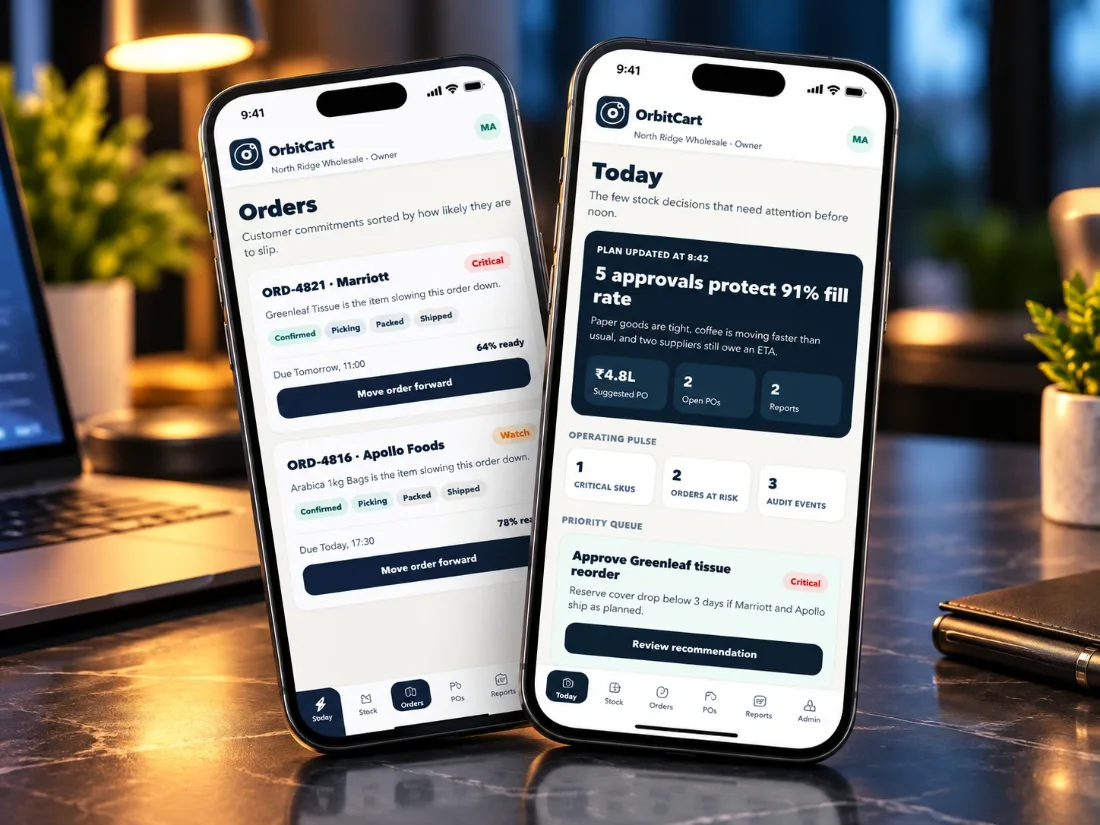
OrbitCart gives sales and warehouse teams a single operating surface: order health, inventory movement and next-best reorder actions, with supplier conversations sitting beside the products they affect. The AI layer surfaces reorder timing, supplier risk and fulfillment priorities for managers to review.
A note on what follows: OrbitCart is a working build that isn't live yet, so we're not claiming usage numbers or results. The code in this post is illustrative TypeScript that shows the pattern. It isn't copied from OrbitCart's source.
Four signals, each with a known source
The AI layer combines four signals into a recommendation. Before deciding what the model should do with them, it helps to write down where each one comes from:
- Sales velocity: how fast a product is selling, calculated from order history in the database.
- Available stock: what's on hand minus what's already reserved for open orders, also from the database.
- Supplier lead time: how long a vendor usually takes to deliver, from purchase records, plus whatever the latest supplier messages say about delays.
- Fulfillment pressure: open orders that depend on this product, and how close they are to their promised dates.
Three of those four are facts the system already holds. Only one part, reading what a supplier actually said in a message, needs language understanding. That split shapes the whole design: plain code does the stock math, and the model does the reading and the explaining.
Keep the stock math in plain code
When to reorder is a well-understood calculation. If a product sells a certain number of units a day and the supplier takes a certain number of days to deliver, you can work out when the shelf will run dry. A language model can do that arithmetic, but it can also do it slightly wrong, and a reorder point that's off by a few days is exactly the kind of mistake nobody spots until a customer order can't ship.
type StockFacts = {
  onHand: number;
  reserved: number;        // already promised to open orders
  dailyVelocity: number;   // units per day, from order history
  leadTimeDays: number;    // from purchase records
  safetyDays: number;      // a rule the manager can adjust
};

// Arithmetic, not inference: the same inputs always give the same answer.
function reorderCheck(f: StockFacts) {
  const available = f.onHand - f.reserved;
  const daysOfCover = f.dailyVelocity > 0 ? available / f.dailyVelocity : Infinity;
  const needsReorder = daysOfCover <= f.leadTimeDays + f.safetyDays;
  return { available, daysOfCover, needsReorder };
}The safety margin is a rule, not a guess. OrbitCart's admin controls let managers adjust reorder rules, so a manager who wants more buffer on a critical product changes a number they can see, rather than rewording a prompt and hoping the model behaves differently.
Every suggestion carries its reasons
The AI layer is designed to explain why a product needs attention. A suggestion that just says "reorder 200 units" asks the manager to trust it or redo the work. A suggestion that shows why lets them agree in seconds, or spot the one input that's wrong.
So each recommendation is built from structured reasons, and every reason points at data the manager can open:
type Reason =
  | { kind: "demand"; text: string; velocityNow: number; velocityPlan: number }
  | { kind: "cover"; text: string; daysOfCover: number; leadTimeDays: number }
  | { kind: "supplier"; text: string; messageId: string }
  | { kind: "orders"; text: string; orderIds: string[] };

type ReorderSuggestion = {
  productId: string;
  quantity: number;     // from the rule, not from the model
  reasons: Reason[];    // the model may phrase these, never invent them
  status: "pending";    // only a person can change this
};The model's job here is phrasing: turning "velocity 34 against a plan of 20, 6 days of cover, 9-day lead time" into a sentence a busy manager reads on a phone. Plain code checks that each reason refers to a real message or real orders before the suggestion is shown. It's the same habit we use in Proofly, where the model's claims are checked against the merchant's own records.
Supplier risk: where the model earns its place
One of OrbitCart's signals flags vendors with delayed updates or longer-than-usual lead times. Part of that is arithmetic: compare a supplier's recent delivery times with its usual ones, or notice that an expected delivery date has passed without an update. Plain code handles both.
The part that needs a model is the message itself. A supplier writes that a shipment is "held at the port until next week", or that a product line is being discontinued. No timer catches that. The model reads new supplier messages and proposes a flag, with the sentence that triggered it.
Two rules keep that useful rather than noisy:
- A supplier flag can raise attention on a product, but it can't lower it. If the stock math says a product is about to run out, a cheerful supplier message doesn't hide it.
- Every flag quotes the message it came from, and plain code checks that the quote really appears in that message. A flag the manager can't trace back to a real sentence gets dropped.
The asymmetry is deliberate. A wrong supplier flag costs a manager a few seconds of reading. A model that could clear a warning could let a stock-out happen quietly, and nobody would see it until a customer order missed its date.
Reorders are approved, never changed silently
OrbitCart's rule is simple: reorder decisions stay reviewable and are never changed silently. The AI prepares the decision and a manager makes it. That matters more in commerce than in many other AI workflows, because a purchase order is money leaving the business and a commitment to a supplier that's awkward to take back.
In practice that means separating what the system suggested from what a person decided, and recording both. The build direction calls for audit-friendly admin actions, so each approval is worth saving with:
- The suggestion as it was shown, including its reasons.
- Who approved, edited or rejected it, and when.
- The quantity that was actually ordered, if it differed.
- Any rule change a manager made at the same time.
That record answers the obvious question later (why did we order this?) and it shows where the suggestions are weakest. If managers keep cutting the quantity on one product category, that's a rule to revisit, not a model to blame.
We wrote more about where to draw this line in our post on human-in-the-loop handoffs, and about the same suggestion-versus-decision split in FlowDesk's AI triage.
Designed to be approved on a phone
OrbitCart is mobile-first because the people making these calls often aren't at a desk. Stock movement, reserved quantities and reorder thresholds are shaped into screens that are quick to scan, and priority queues show delayed orders, fulfillment risk and the next action needed by sales or warehouse teams.
That constraint helps the AI design. A phone screen has room for a product, a quantity and two or three short reasons, and not much else. If a suggestion can't justify itself in that space, it probably isn't clear enough to approve anywhere. A few principles we'd apply to any mobile approval flow:
- Show the reasons on the approval screen itself, not one tap away. A reason people have to go looking for is a reason they'll skip.
- Confirm an approval only once the server has accepted it. A purchase order that looks sent on the phone but never reached the backend is worse than a slow button.
- Make edits easy. Changing the quantity before approving should be a first-class action, not a reject-and-start-again.
- Keep supplier context beside the product, so the manager doesn't switch apps to check what the vendor last said.
The stack for this build is React Native, Node.js, PostgreSQL, OpenAI, AWS and Stripe, with a clean handoff path for future ERP or accounting integrations. None of the patterns above depend on those choices.
The takeaway
AI reorder suggestions are only worth having if a manager can approve them faster than they could work the answer out themselves. That comes down to explanation and trust, not model size. Before building one, we'd want an answer to each of these:
- Which signals are facts the system already holds, and which genuinely need a model?
- Is the reorder math in plain code, with rules a manager can see and change?
- Does every suggestion carry reasons that link to real records or messages?
- Can the model raise a warning without being able to clear one?
- Are suggestions and final decisions stored separately, with who decided and when?
- Can a manager understand and approve a suggestion on one phone screen?
Read more about the build in our OrbitCart case study, or see how we approach this work for clients on our mobile app and AI automation pages. If your sales and warehouse teams are working from different numbers, get in touch.